
How to write progress notes faster (without cutting corners)
SOAP, DAP or BIRP, a few reusable phrases, and a simple routine that gets your notes done before the day ends.
Tools for Therapists 8 min read
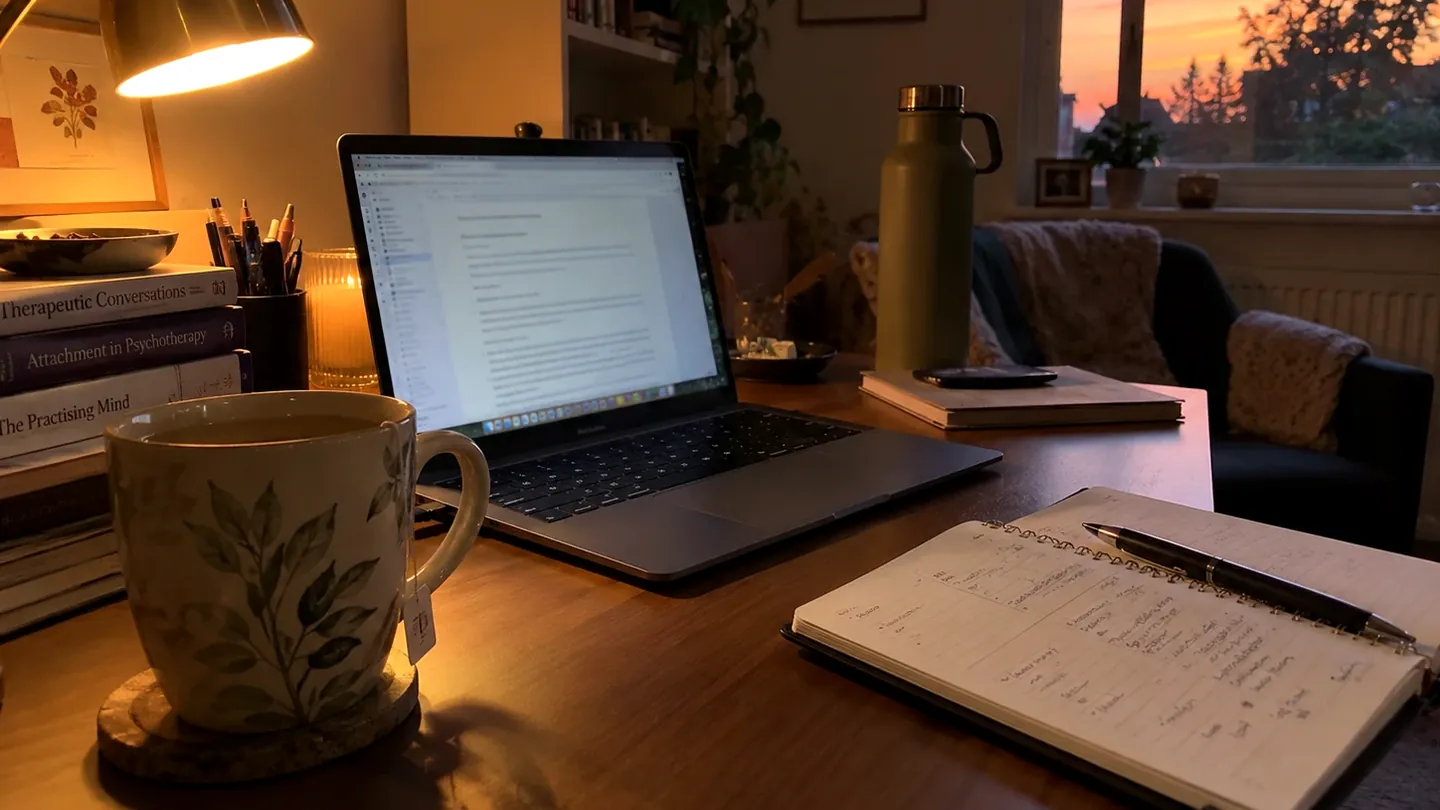
It’s Thursday, a little after six. The last client left forty minutes ago, the kettle has boiled twice, and there are eleven notes still open. Monday’s are in there too. You know what happened in each session. You could tell a colleague in two minutes. And yet each note takes twenty, because somewhere between the session and the keyboard, writing it down became a small exam.
If that sounds familiar, the problem probably isn’t your typing speed. It’s that nobody ever told you what a progress note is actually for, so you write it for every possible reader at once: your supervisor, a court, an insurer, a future you, and the client who might one day ask to see it. That’s a lot of people to please before dinner.
Here’s how to write notes that are quicker and better, which, it turns out, is mostly the same thing.
First, know what the note is for
A progress note has a few honest jobs. It keeps care continuous, so you (or a colleague covering your leave) can pick up where things stand. It shows your clinical reasoning: what you noticed, what you did, why. And it’s a record of what happened, which matters for your professional body and, if you bill insurance, for payment.
What it isn’t is a transcript. It doesn’t need every topic, every quote, or every clever thing you nearly said. The most useful test I know is this: could a competent colleague read it in a minute and safely see your client tomorrow? If yes, the note is done. Everything beyond that is either for you, or for nobody.
Pick one format and stop shopping
SOAP, DAP, BIRP, GIRP, PIE. There’s a whole alphabet of note formats, and each one has its fans. Honestly, the format matters much less than using the same one every time. A fixed structure means you stop deciding where things go, and deciding is the slow part.
Here’s one ordinary session, a client we’ll call Sam who’s working on anxiety at work, written up three ways. Notice how short each one is, and how little it loses.
- Subjective
- Sam reported two panic episodes this week, both in the hour before team meetings. Completed thought records on 3 of 7 days. Said: “I keep thinking they’ll realise I don’t know what I’m doing.”
- Objective
- Arrived on time. Restless for the first ten minutes, then settled. Speech normal in rate and volume. Affect anxious, brighter by the end. GAD-7: 12 (15 at intake).
- Assessment
- Anxiety still moderate but easing. Avoiding speaking in meetings appears to be keeping the fear going. Engaged well with cognitive restructuring. No risk indicators; no change since last review.
- Plan
- Daily thought records. First exposure step: one comment in Monday’s meeting. Review both next session, 14 Oct.
Good for: Medical and multidisciplinary settings, where colleagues already think in SOAP.
If your service already uses a format, use that. If you’re in private practice and starting fresh, DAP is the easiest to keep up on a busy day. Three headings, and nobody argues about whether a sigh is subjective or objective.
Write it while the session is still warm
A note written five minutes after a session takes a fraction of the time of one written three days later. That’s not a productivity trick, it’s just memory. On the day, you know what mattered. By the weekend, you’re reconstructing, and reconstructing invites the over-writing that makes notes long.
So protect the gap. If your sessions run back to back, try ending them at fifty minutes and using the next five for the note. It feels like losing time. It’s actually where you get the evening back.
What your notes cost you in a year
Move the sliders to match your week.
Now
304 h
At your goal
135 h
Given back
169 h
about 23 working days
Run your own numbers above. Most people are surprised, and slightly cross, at how much of their year goes on notes written late.
Try writing some of it with the client
Collaborative documentation, sometimes called concurrent documentation, means writing part of the note with the client in the last few minutes of the session. It sounds odd the first time. In practice it can be lovely.
You turn the screen a little and say something like, “Let me just jot down what we covered and what you’re trying this week. Tell me if I’ve got it right.” Clients often like being part of it. It doubles as a summary, it makes the homework clearer, and you walk out of the room with the plan already written.
It isn’t right for every session. Not in a crisis, and not when the last ten minutes have been the hardest. But for routine work it can take a note from twenty minutes to almost nothing.
Build a phrase bank, then don’t hide behind it
Most notes reuse the same dozen sentences, and there’s no prize for rewording them every time. Keep a short bank of plain, behavioural phrases and drop them in.
A starter phrase bank (tap to copy)
Client reported…
For what they told you, in their words where it matters.
Practised [skill] in session; client was able to…
Homework reviewed: completed on [x] of [y] days.
Affect anxious at the start, brighter by the end of session.
Engaged throughout; generated alternatives with little prompting.
Risk asked about directly; no current concerns reported.
Only if you actually asked. Never write it from habit.
Risk reviewed: no change since last assessment on [date].
Plan: [task] before next session on [date]; will review together.
One warning. A phrase bank is a scaffold, not a costume. If every note for every client reads identically, the record stops saying anything about the actual person, and that’s the corner we promised not to cut. Use the stock phrases for the routine parts, and put your real attention into the one or two sentences that are only true of this client, this week.
Know what to leave out
Shorter notes come as much from what you skip as from what you write. You can usually leave out:
- Long verbatim quotes. One short quote that captures a key belief is gold. A paragraph of dialogue is a transcript.
- Detail about other people. The client’s sister’s affair is part of the story, but her name and the specifics probably don’t belong in your client’s record.
- Speculation dressed as fact. “Possibly linked to early attachment” is a hypothesis. Keep hypotheses in supervision or in your private notes, and keep the record to what you observed and did.
- Labels instead of behaviour. “Client was manipulative” tells a reader about you. “Client asked three times to extend the session and became tearful when declined” tells them about the session.
A sixty-second check before you sign
Last thing. Before you close the note, run through these. It takes a minute, and it’s the difference between fast and careless.
Before you sign
0 / 6
The real goal
Fast notes aren’t about squeezing in another client. They’re about the quiet hour after work that belongs to you, and about walking into Monday without a backlog humming in the background. A good note is short, honest and written on the day. Everything else is decoration.
So tomorrow, try one thing: pick your format, protect five minutes after the first session, and write the note before the next client arrives. See how it feels. Then do it again.
This article is for professional education and doesn't replace clinical training or supervision.